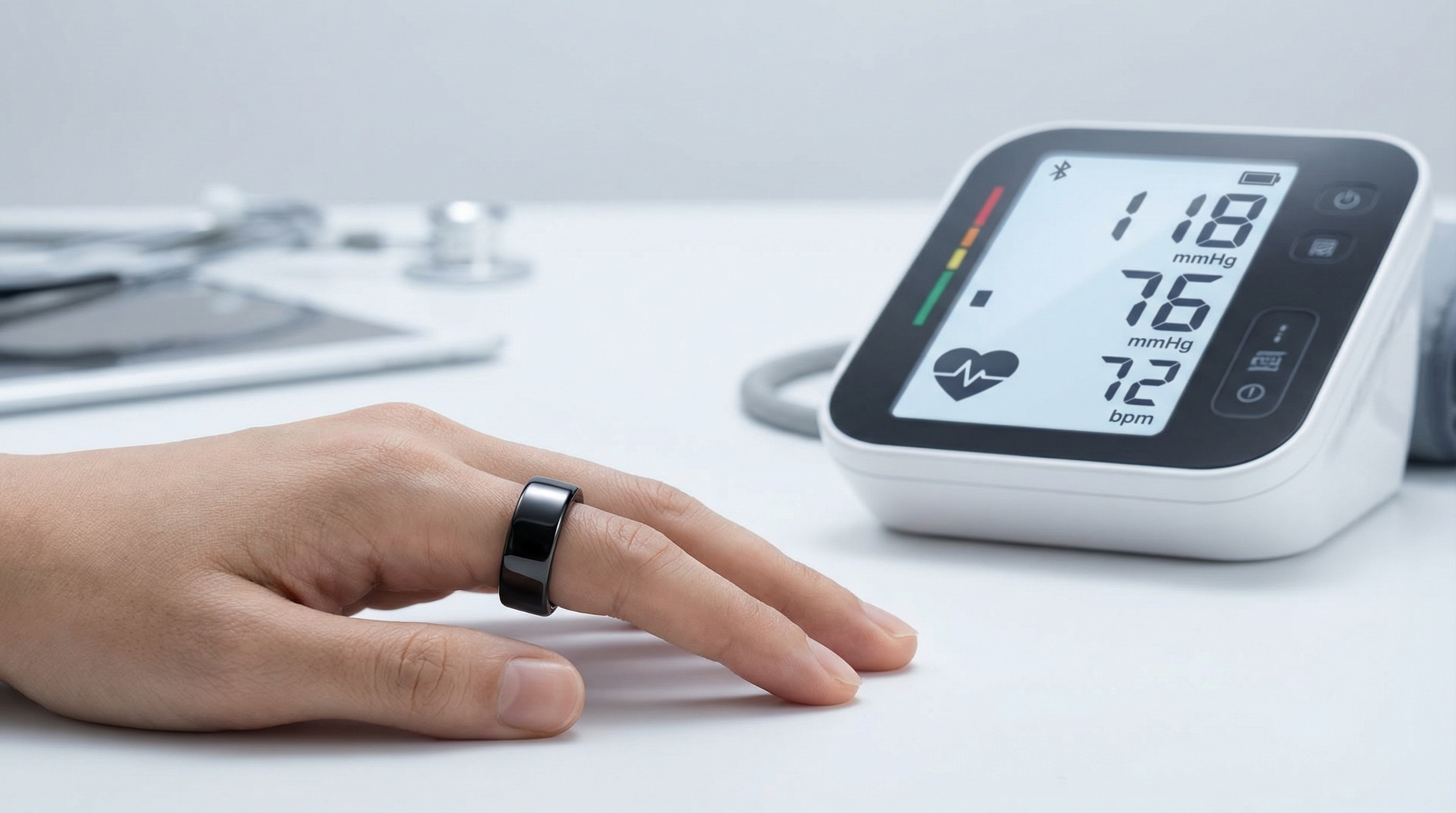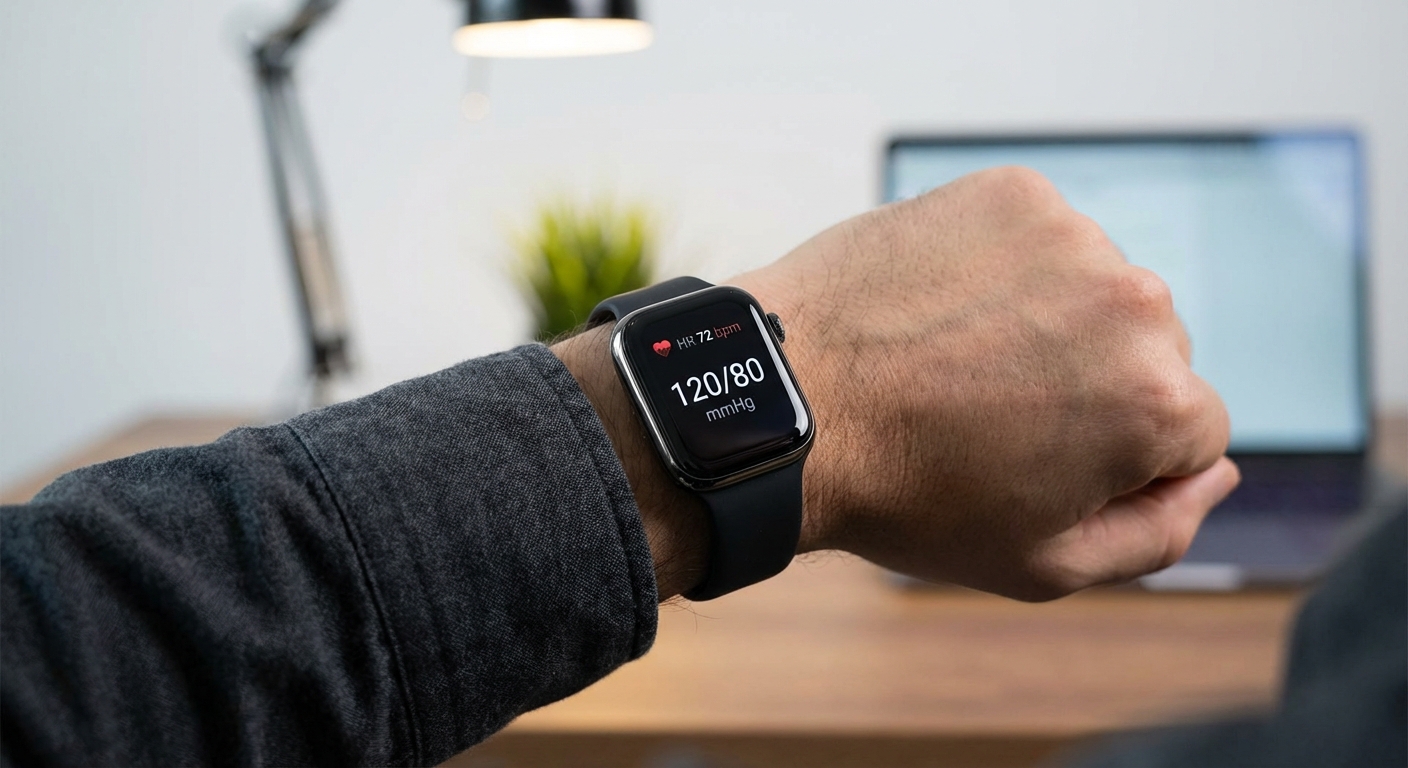

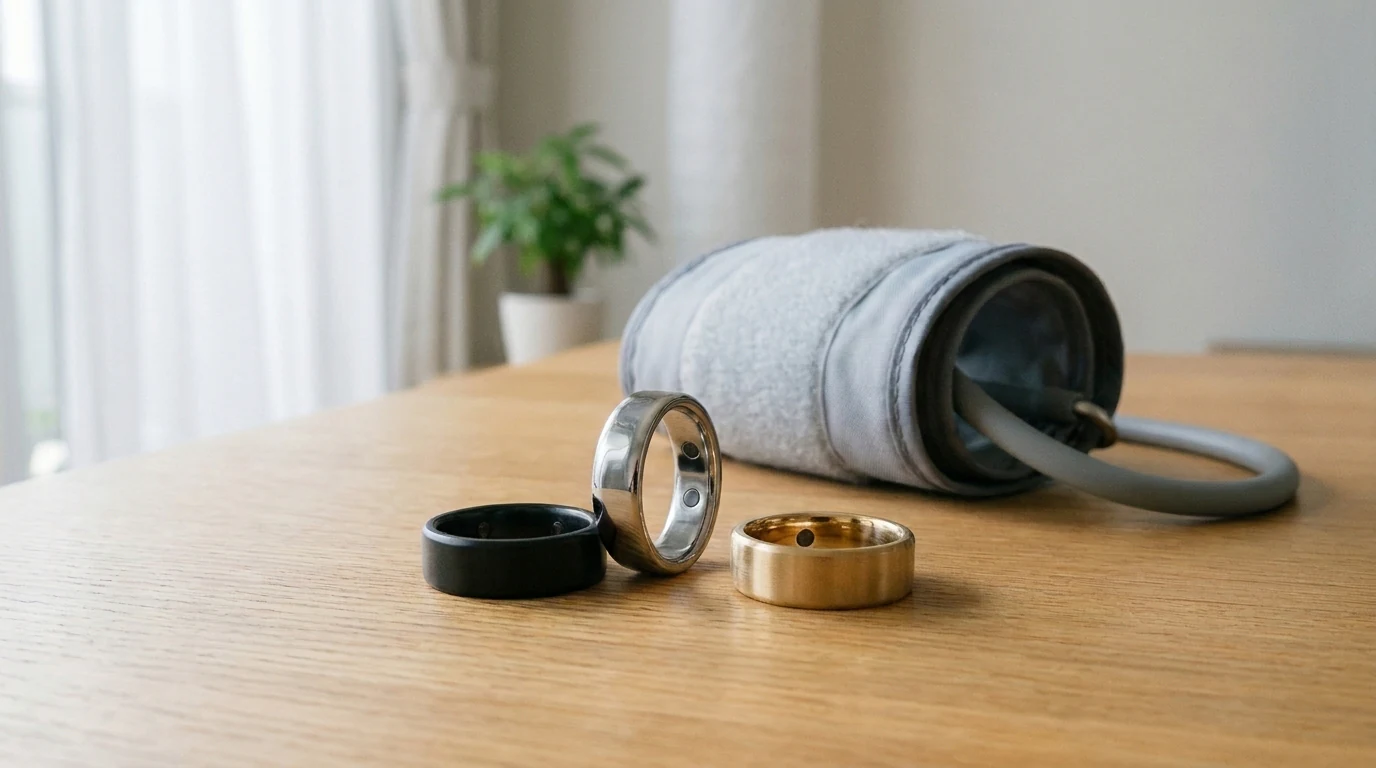
A smart ring can measure blood pressure only in a narrow sense today. One ring, the Happy Ring, has US Food and Drug Administration clearance to take spot-check readings. One more, Circular Ring 2, shows estimates in mmHg as a wellness feature once you calibrate it with a cuff. The rings most people have heard of, Oura and RingConn, show trends and alerts with no numbers, and the Samsung Galaxy Ring has no blood pressure feature at all.
Every product detail below was checked against the maker's own website or the FDA database on 24 November 2026. Ring features change quickly, so treat the date as part of the answer.
Which smart rings do anything for blood pressure?
| Ring | What you see | Cuff needed? | Status in the maker’s or FDA’s words |
|---|---|---|---|
| Happy Ring | Spot-check systolic and diastolic readings | No | FDA-cleared (K254000), adults aged 22 to 50, by prescription |
| Circular Ring 2 | Systolic and diastolic estimates in mmHg | Yes. Three readings to start, then one every 30 days | A wellness device, not a medical device |
| Oura Ring 5, Ring 4 and Gen3 | A notification if a pattern is flagged, plus a night-time dipping category. No numbers | No | For wellness use only |
| RingConn Gen 3 | A vascular health trend. No numbers | Optional. RingConn recommends entering cuff readings | Not a medical device |
| Circul Ring 3 and Ring 2 MAX | A blood pressure trend view | An in-app calibration is required | For research and innovation purposes only |
| Samsung Galaxy Ring | Nothing for blood pressure | Not applicable | Samsung’s blood pressure feature is on its watches |
| Ultrahuman Ring AIR and Ring PRO | Nothing for blood pressure | Not applicable | A related research programme is listed as coming soon |
The rings fall into three groups: one that is cleared to give readings, rings that show estimates or trends as wellness features, and rings with no blood pressure feature. The sections below take them in that order.
The one ring cleared to measure blood pressure
Happy Ring
The Happy Ring, from Happy Health in Austin, is the only smart ring with FDA clearance for blood pressure readings. The FDA's database lists the clearance as K254000, decided on 3 September 2026, under the same product code the agency uses for blood pressure monitors.
The clearance is narrower than the headline suggests. According to the FDA summary, the device is intended for spot-check measurements of systolic and diastolic pressure in adults aged 22 to 50, and it needs no calibration with a cuff. It is not intended for people with heart rhythm problems such as atrial fibrillation, people with severe blood vessel disease, or anyone who is pregnant, and it is not meant to be used during movement. The summary reports a validation study in 85 people against a pressure sensor placed inside an artery, with an average error under 1 mmHg and a spread of about 6 mmHg for the top number.
You cannot buy it off the shelf. Happy Health's site says the ring is available by prescription from one of its physicians, starting at $399, with six months of monitoring included and $15 a month after that.
Rings that show estimates or trends as wellness features
Circular Ring 2
Circular Ring 2 shows actual numbers and is sold directly to consumers. Since September 2026 each reading you start gives a systolic and diastolic estimate in mmHg. Circular says the ring records an electrical heart signal (ECG) and a light-based pulse signal at the same moment and uses the delay between them, which it calls pulse wave transit time.
It depends on a cuff. Circular asks you to enter three readings from a standard cuff monitor to set it up, and one more every 30 days. The company describes the ring as a wellness device and says the values must not be used for diagnosis, treatment or any medical decision, including starting or adjusting medication. The ring costs $349, one reading a day is free, and more readings need a $2.99 monthly add-on.
Oura Ring 5, Ring 4 and Gen3
Oura does not show a blood pressure number on any ring. Its feature, Blood Pressure Signals, looks at night-time pulse data across 30-day periods and sends a notification only when it finds a pattern worth your attention. A second view sorts your nights by how much your blood pressure pattern appears to dip during sleep. Oura's support pages say the feature does not measure blood pressure in mmHg, cannot diagnose or rule out any condition, and is for wellness use only.
The feature is software, so it runs on Oura Ring 5, Ring 4 and Gen3 with an active membership. It needs at least 15 nights of data from the past 30, it uses no cuff calibration, and it switches off for members using pregnancy tracking. You can type in cuff readings to keep them in the app, and Oura says those do not feed the feature. Our Oura Ring blood pressure guide covers it in more detail.
RingConn Gen 3
RingConn Gen 3, released in May 2026, shows a vascular health trend and no blood pressure reading. RingConn says the Gen 3 provides trend insights and no individual systolic and diastolic measurements, and that the ring is not a medical device. The feature is on the Gen 3 only, which starts at $349 in the United States.
RingConn's own material differs on the cuff. Its website calls cuff readings optional, while its launch announcement says the system needs periodic calibration and recommends entering readings three times in the first 24 hours and monthly after that. If you buy one, plan on owning a cuff. Our RingConn guide has the full story.
Circul Ring 3 and Ring 2 MAX
Circul rings show a blood pressure trend view after an in-app calibration. The maker's care guide says its cuff-free blood pressure monitoring is intended for research and innovation purposes only and is not a medical diagnostic tool, and the homepage says the rings are for general wellness use. The FDA database shows one clearance for an older Circul ring, and it covers blood oxygen measurement, with nothing for blood pressure.
Rings with no blood pressure feature
The Samsung Galaxy Ring tracks heart rate, sleep and skin temperature, and blood pressure is not among its features. Samsung's blood pressure monitoring runs on Galaxy Watch4 and later watches, which have to be calibrated with an upper-arm cuff every 28 days. Our guide to Samsung Galaxy Watch blood pressure explains how that works.
The Ultrahuman Ring AIR and Ring PRO have no blood pressure feature either. Ultrahuman lists an opt-in research study on night-time signals related to blood pressure as coming soon, and describes that programme as wellness research with no medical use.
Rings that have been announced
Two more rings are worth knowing about, and neither could be confirmed as on sale. The Signal Ring, from a US company, promises blood pressure numbers with no calibration. Its own site says it is not a medical device, and its launch announcement says it has not been reviewed or cleared by the FDA. The CART ring from Sky Labs in South Korea is being sold as a medical device, with European certification announced in January 2026 and UK authorisation in May 2026, and the company plans to offer it through prescriptions.
Cheap rings that promise a reading
Why can a ring show blood pressure without FDA clearance?
A ring can show blood pressure estimates without clearance when it is sold strictly as a wellness product. The FDA updated its general wellness guidance on 6 January 2026. The guidance says the agency may treat products that use optical sensing to estimate measures such as blood pressure as general wellness products when the output is meant only for wellness use, is not presented as a substitute for a cleared device, and does not show clinical-looking values unless the maker has validated them.
The same guidance draws a line. A product stops being a wellness product when it is intended to measure or report values for medical purposes, including screening, diagnosis, monitoring or managing a condition. That is why the makers above repeat that their features are for wellness only, and why a ring needs clearance, as the Happy Ring has, before it can be marketed for medical use.
What do the guidelines say about cuffless devices?
The guidelines advise against relying on them. The 2025 AHA/ACC high blood pressure guideline does not recommend cuffless devices for diagnosing or managing hypertension. The 2024 European Society of Cardiology guideline says none of the cuffless methods are currently recommended for routine clinical use, and that there is not yet scientific agreement on how their accuracy should be tested.
The American Heart Association looked at the question in a scientific statement published in Hypertension in 2026 (Cohen and colleagues). It concluded that the devices on the market have not yet been adequately vetted for accuracy, and the association's summary says they should not be used at this time to diagnose, track or treat high blood pressure. The summary also points out that FDA clearance of a blood pressure device does not require accuracy testing under a standardised protocol, which is worth remembering when you read the word "cleared".
Can a smart ring replace a blood pressure cuff?
A smart ring cannot replace a cuff today. Even the cleared ring covers spot checks in a limited age range and leaves out people with rhythm problems and anyone who is pregnant, and the rest are wellness features by their makers' own description. The reading your doctor will act on still comes from a validated upper-arm cuff, taken the right way. Our guide to home blood pressure monitors lists cuffs worth buying, and how to take an accurate reading covers the technique.
What a ring adds is context between cuff readings. It is on your finger all night, when a cuff is not, so a trend or an alert can be a useful prompt to measure properly and to raise the pattern with your doctor.
Which ring fits which need?
| If you want | Look at | Keep in mind |
|---|---|---|
| A blood pressure reading a regulator has cleared | Happy Ring | Prescription only, cleared for ages 22 to 50 |
| Numbers on your finger and you already own a cuff | Circular Ring 2 | A wellness estimate that needs cuff calibration every 30 days |
| A heads-up if your night-time pattern changes | Oura Ring | No numbers, and it needs a membership |
| A vascular health trend view | RingConn Gen 3 | No numbers, and RingConn recommends entering cuff readings |
| Blood pressure from Samsung | A Galaxy Watch, not the Galaxy Ring | Calibrated with a cuff every 28 days |
If your goal is to manage high blood pressure, start with the cuff and add a ring later if you want the extra context. Other wearables are covered in our guides to wearable blood pressure monitors and smartwatches that measure blood pressure.
How to use a ring alongside a cuff
Use the cuff for the numbers and the ring for the pattern. Measure with a cuff twice a day for a week when you want a clear picture, and keep those readings in one place. When a ring flags a change or its trend moves, take a cuff reading at the same time of day for the next few days and see whether the cuff agrees.
Cardilog keeps your cuff readings together and shows how they trend, so you can set a ring's alerts beside real measurements and bring both to your appointment. If a cuff reading is higher than 180/120, follow the steps on our blood pressure chart and do not wait for a ring to confirm it.