
Monitor your blood pressure with a 30 seconds face scan
Iaso uses your phone's front camera to monitor your blood pressure, heart rate, heart-rate variability and breathing rate, with no cuff, no wearable and nothing to charge.
Iaso is not a medical device.

Scan with your camera
A scan takes thirty seconds and needs nothing but the phone in your hand.

Hold your phone at eye level
Face a window or a lamp so the light falls on your face, and hold the phone where you can see yourself on the screen.
Stay still for thirty seconds
Iaso reads tiny colour changes in the skin of your face as blood moves through it.
See your readings
You get systolic and diastolic blood pressure, heart rate, heart-rate variability and breathing rate. If the signal was weak, the reading says so.
How a camera finds your pulse
Every heartbeat pushes a little more blood into the skin of your face, and that blood absorbs some of the light that would otherwise bounce back. A phone camera can pick up the tiny change in colour this causes, even though your eyes can't. The technique is called remote photoplethysmography, or rPPG for short, which means measuring your pulse with light without touching you.
Light that reaches your face travels a little way into the skin, and the blood in the tiny vessels near the surface absorbs some of it before the rest bounces back. Each heartbeat fills those vessels a bit more, so slightly less light comes back. Green light shows the change best, because haemoglobin, the part of blood that carries oxygen, absorbs green strongly. The green light on the back of a smartwatch works the same way, and a face scan uses the light already in the room.
The scan finds your face in every frame and follows patches of skin where the pulse shows well, such as the forehead and cheeks. It leaves out your eyes, mouth and hair, because they move or carry no pulse. The change in a single pixel can be smaller than the smallest step the camera records, so the scan averages every pixel in a patch into one colour for each frame. Once that colour is taken, the frame itself is no longer needed.
The raw colour also shifts when the light changes or your head moves, and those changes are usually bigger than the pulse itself. A heartbeat repeats at a steady pace, so filters keep only the rhythms a heartbeat can have and set the rest aside. The scan runs for thirty seconds because a rhythm only becomes clear over many beats. Movement and dim light can still bury the pulse, and darker skin absorbs more light before it reaches the blood, which leaves a fainter signal, so soft, even light on your face always helps.
Counting the beats gives your heart rate, and the small differences in the time between them give your heart-rate variability. Breathing gently lifts and lowers the whole trace, which gives your breathing rate. Blood pressure is the hardest of the four, and the research on it is the newest. The timing and shape of each beat carry clues about your circulation, and a measurement model turns those clues into a reading. Calibrating with your own cuff teaches the model how your circulation behaves, and for anything that matters clinically, a cuff is still the reference.
Where this comes from
- Remote plethysmographic imaging using ambient lightVerkruysse, Svaasand and Nelson, Optics Express, 2008
- Non-contact, automated cardiac pulse measurements using video imaging and blind source separationPoh, McDuff and Picard, Optics Express, 2010
- Algorithmic principles of remote PPGWang, den Brinker, Stuijk and de Haan, IEEE Transactions on Biomedical Engineering, 2017
- Influence of skin type and wavelength on light wave reflectanceFallow, Tarumi and Tanaka, Journal of Clinical Monitoring and Computing, 2013
- Multiparameter respiratory rate estimation from the photoplethysmogramKarlen, Raman, Ansermino and Dumont, IEEE Transactions on Biomedical Engineering, 2013
- Camera measurement of physiological vital signsMcDuff, arXiv, 2021
- Cuffless devices for the measurement of blood pressure: a scientific statement from the American Heart AssociationCohen, Byfield, Hardy, Juraschek and colleagues, Hypertension, 2026
Four readings from one scan
Every scan gives you the same four readings, and each one is saved to your history.
118/76mmHg
You get systolic and diastolic, the top and bottom numbers of a blood pressure reading.
64bpm
It counts your pulse in beats per minute.
48ms
It shows how much the time between heartbeats changes from one beat to the next.
14/min
It counts how many breaths you take in a minute.
The signal and the values on this page are illustrative.
See how your readings move over time
Look back over a week, a month or a year, and drag through your charts one value at a time. Every reading sits in one history, which you can narrow to a single source.
Trends
Blood pressure
Avg 119/77 · last week
Blood pressure chart. 7 readings, from 121/78 to 120/77. Systolic ranged 116 to 124.
62bpm
Resting, from scans
49ms
7-day average
14/min
Resting, from scans
Resting heart rate
Avg 62 bpm · last week
Resting heart rate chart. 7 readings, 62 to 62 bpm, ranging from 61 to 63.
Heart-rate variability
Avg 49 ms · last week
Heart-rate variability chart. 7 readings, 48 to 50 ms, ranging from 46 to 53.
Hover over or drag across a chart to read each value. The readings here are illustrative.
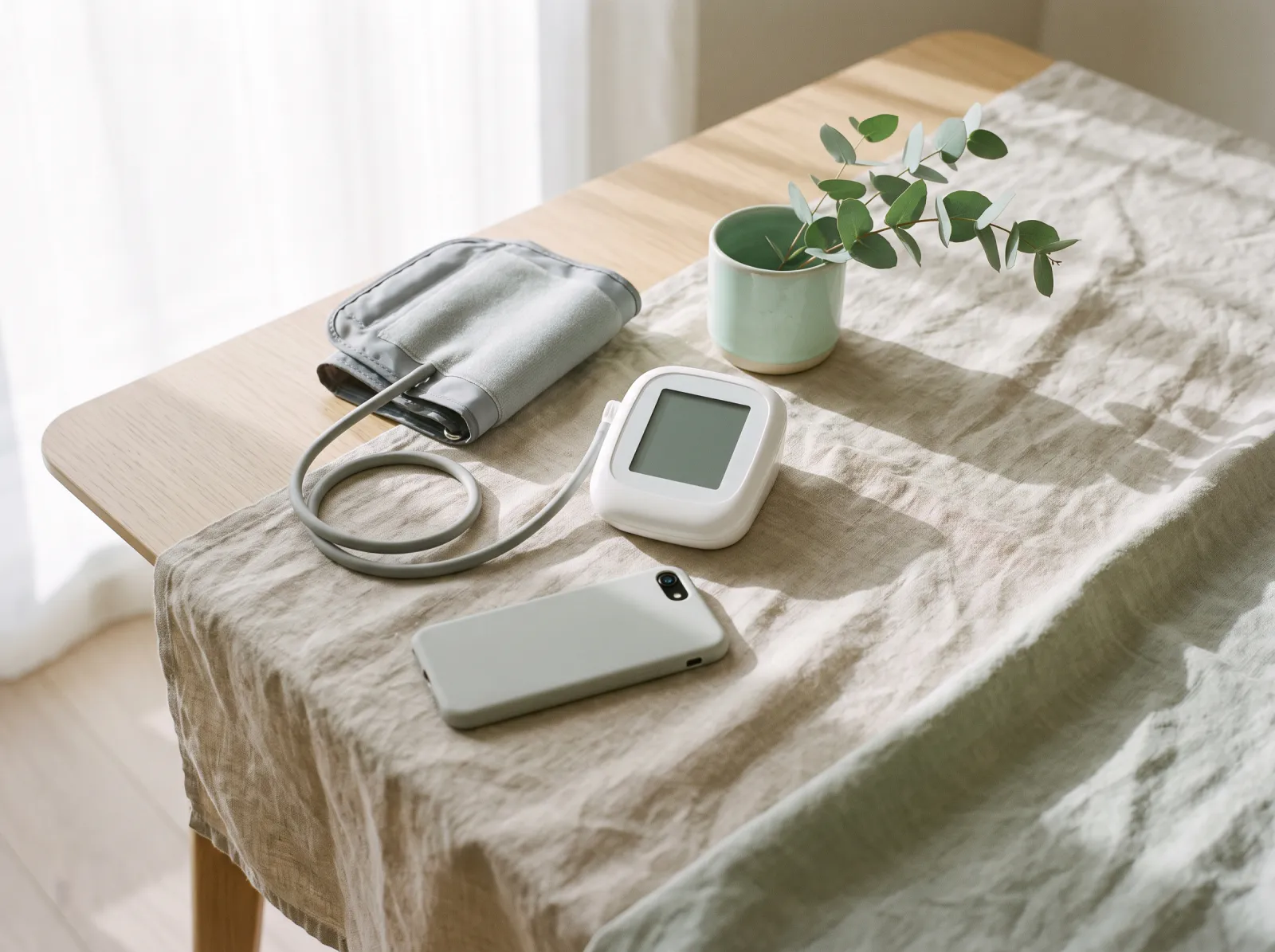
- Have a cuff monitor and a quiet ten minutes.
- Enter your cuff readings when Iaso asks for them.
- Take the face scans Iaso asks for, so it can learn how your own circulation behaves.
Calibrate with a cuff
Calibrating against a cuff monitor teaches the model how your own circulation behaves, which brings your blood pressure readings noticeably closer to what your cuff shows.
Calibration is optional. Until you do it, scans use the general model.

Your readings stay on your phone
No account to create
There's nothing to sign up for, and your readings are stored in a database on your phone.
Nothing is filmed
Camera frames are read as they arrive and then discarded, so no video or photo of your face is kept.
Sync when you say so
Health sync stays off until you turn it on.
Joining the waitlist on this page is separate from the app. It sends your name and email to Cardilog so we can tell you when Iaso launches.
Works with Apple Health and Health Connect
Iaso syncs with Apple Health on iPhone and iPad, and with Health Connect on Android. Sync stays off until you turn it on.

What goes out
Each scan's readings are written to your health app.
- Blood pressure
- Heart rate
- Heart-rate variability
- Breathing rate
What comes back
Readings from other sources join your Iaso history.
- Blood pressure from a cuff or another app
- Resting heart rate
Built for everyone

Text that follows your settings
Text grows with the size you set for the rest of your phone.
Dark mode
Use Iaso in light or dark mode.
VoiceOver
Iaso has full VoiceOver labels, including a spoken description of every chart.
English, Spanish and French
The whole app is available in all three languages.
iPhone and iPad
Iaso works on iPad as well as iPhone.
Questions about Iaso

Be the first to try Iaso
Join the waitlist and we'll email you when Iaso launches.
About these readings
A camera reading is not a diagnosis. Iaso is not a medical device and does not tell you whether a reading is normal, high or low. For anything that matters clinically, check with a cuff monitor and talk to your clinician. Never change medication based on this app.