
GLP-1 medications lower systolic blood pressure by roughly 2 to 5 mmHg, and tirzepatide lowers it most. That figure comes from a 2026 state-of-the-art review in the American Journal of Hypertension, which pooled the evidence across people with diabetes, people with obesity, and people at high cardiovascular risk. The drop is modest next to a dedicated blood pressure tablet, and it is consistent enough that it now shows up in how cardiologists think about these medications.
The more useful question is which one does what, and that is where published comparisons get slippery. The numbers you see quoted for different GLP-1s were collected in different ways, over different timeframes, in different kinds of patients. This guide lines them all up, says how each figure was measured, and explains what to actually watch for if you are starting one.
Which GLP-1 lowers blood pressure most
Here is every GLP-1 medication that has blood pressure evidence behind it, including one that is still in development. The final column matters more than it looks, and the next section explains why.
| Medication | Brand names | How it works | Typical systolic change | How it was measured | Main evidence |
|---|---|---|---|---|---|
| Tirzepatide | Mounjaro, Zepbound | GIP and GLP-1 together | About 7 to 11 mmHg below placebo over 24 hours; 4.8 mmHg better than other weekly agents | 24-hour ambulatory monitor, plus office readings | de Lemos 2024; Xu 2025 |
| Semaglutide (injection) | Ozempic, Wegovy | GLP-1 | Around 3 to 5 mmHg at the 2.4 mg dose | Office readings | Moiz 2026; Lincoff 2023 |
| Semaglutide (tablet) | Rybelsus | GLP-1 | Within the class range, and less studied than the injection | Office readings | Husain 2019; Lu 2026 |
| Liraglutide | Victoza, Saxenda | GLP-1 | About 2.2 mmHg, pooled with exenatide | Seated office readings | Katout 2014; Marso 2016 |
| Dulaglutide | Trulicity | GLP-1 | Modest, and the smallest of the weekly injections | Office readings | Xu 2025; Gerstein 2019 |
| Exenatide | Byetta, Bydureon | GLP-1 | About 2.2 mmHg, pooled with liraglutide | Seated office readings | Katout 2014; Holman 2017 |
| Lixisenatide | Adlyxin | GLP-1 | Little dedicated blood pressure evidence; studied mainly for cardiovascular safety | Office readings | Pfeffer 2015 |
| Retatrutide (in development) | Not yet approved | GIP, GLP-1 and glucagon | About 6.8 mmHg | Office readings, pooled across trials | Simental-Mendía 2026 |
| Orforglipron (Foundayo) | Weight management, approved August 2026 | GLP-1, taken as a daily tablet | Improves systolic pressure as part of a broader cardiometabolic effect | Office readings, network comparison | Lu 2026 |
The clearest head-to-head evidence comes from a 2025 Bayesian network meta-analysis of once-weekly agents published in Diabetes Research and Clinical Practice. It found tirzepatide 15 mg reduced systolic pressure by 4.8 mmHg more than the other GLP-1 receptor agonists it was compared against, with a confidence interval running from 1.4 to 8.2 mmHg. The same analysis found tirzepatide produced the most weight loss and also the most nausea and diarrhoea, and it concluded that dulaglutide remains the better choice for people who have type 2 diabetes alongside established cardiovascular disease.
Why these rankings can mislead you
Blood pressure can be measured in two very different ways, and the difference is large enough to change which drug looks best.
An office reading is a single measurement taken while you sit in a clinic. A 24-hour ambulatory monitor is a cuff you wear all day and night that takes readings automatically, usually every 20 to 30 minutes. Ambulatory monitoring picks up your true average across waking and sleeping hours, and it tends to produce different numbers from a one-off clinic reading because it removes the anxiety spike many people get in a medical setting.
Tirzepatide has a dedicated 24-hour ambulatory substudy from the SURMOUNT-1 trial, published in Hypertension in 2024. Most of the older GLP-1 evidence rests on seated office readings. So when a comparison table puts tirzepatide at 11 mmHg next to semaglutide at 4 mmHg, part of that gap is a real difference between the drugs and part of it is a difference between the measuring methods. Tirzepatide does come out ahead in the network analysis that compared like with like, and the gap there was 4.8 mmHg rather than the threefold difference the raw figures suggest.
What this means for your own readings
How GLP-1 medications lower blood pressure
Weight loss does most of the work. Losing body weight reduces the strain on your circulation, and the rough rule from the wider literature is about 1 mmHg of systolic reduction for every kilogram lost. Our guide to blood pressure and weight loss covers that relationship in detail.
The 2026 review in the American Journal of Hypertension describes the effect as driven primarily by weight loss, with additional contributions from three mechanisms that work independently of the scale:
- The kidneys clear more sodium. GLP-1 receptors in the kidney increase how much sodium passes into your urine, a process doctors call natriuresis. Less sodium means less fluid held in the bloodstream, and less fluid means lower pressure.
- Blood vessels relax more easily. These drugs improve the function of the thin layer of cells lining your arteries, which is what controls how readily a vessel widens to let blood through.
- Vascular inflammation settles down. Long-running low-grade inflammation stiffens arteries over time, and GLP-1 treatment reduces the markers associated with it.
There is a genuine puzzle in the evidence worth knowing about. A 2014 meta-analysis of 33 trials covering 12,469 people on liraglutide and exenatide found a systolic reduction of 2.2 mmHg, and when the researchers looked for a relationship between that drop and weight loss, they found none. The blood pressure change was unrelated to how much weight people lost, to their starting blood pressure, and to their blood sugar improvement. The most likely reading is that both routes are real, with the direct vascular effects dominating in the older drugs that produced little weight loss, and weight loss dominating in the newer high-dose agents where people lose 15% or more of their body weight.
Blood pressure is only part of the heart benefit
Several of these drugs have been tested for hard outcomes such as heart attack, stroke and cardiovascular death, and the results vary by drug rather than applying to the class as a whole.
- Semaglutide has the strongest evidence in people without diabetes. The SELECT trial, published in the New England Journal of Medicine in 2023, followed more than 17,000 people with obesity and existing cardiovascular disease and found a 20% reduction in major cardiovascular events. SUSTAIN-6 showed a similar direction in people with type 2 diabetes.
- Liraglutide reduced cardiovascular events in the LEADER trial in people with type 2 diabetes at high risk.
- Dulaglutide reduced events in REWIND, which is notable because most of its participants had no previous cardiovascular disease.
- Exenatide and lixisenatide were tested in EXSCEL and ELIXA respectively and showed safety rather than a clear reduction in events.
- Semaglutide in heart failure improved symptoms and physical limitation in STEP-HFpEF, which studied people with obesity and heart failure with preserved ejection fraction.
Blood pressure reduction contributes to these results without explaining them on its own. The trials also recorded improvements in triglycerides, inflammatory markers and blood sugar control, and the benefit appears to come from all of it working together.
The heart rate trade-off
GLP-1 medications lower your blood pressure and raise your resting heart rate at the same time. The 2014 meta-analysis of the older agents measured an average increase of 1.3 beats per minute. Tirzepatide showed larger increases in the SURMOUNT-1 ambulatory substudy, ranging from about 2 to 5 beats per minute depending on the dose.
This combination surprises people, because a faster heart usually goes with higher pressure. The working explanation is that GLP-1 receptors in the heart's pacemaker tissue nudge the rate up directly, while the pressure comes down through weight loss and vessel relaxation on a separate track. For most people the heart rate change is small enough to pass unnoticed, though it is worth mentioning to your doctor if you have a heart rhythm condition or if you start noticing palpitations. Our article on Mounjaro, Zepbound and blood pressure goes through the tirzepatide heart rate data dose by dose.
When blood pressure drops too far
This is the risk that gets least attention and causes the most trouble in practice. A meta-analysis published in Endocrine in August 2026 pooled 32 randomised trials covering 47,332 participants and looked specifically at blood pressure related side effects. Tirzepatide reduced high-blood-pressure events substantially, with a risk ratio of 0.40, and it raised low-blood-pressure events by roughly two and a half times, with a risk ratio of 2.45. The risk climbed further at higher doses. Semaglutide came out broadly neutral on both counts in the same analysis.
Low blood pressure, which doctors call hypotension, tends to announce itself through a recognisable set of symptoms:
- Dizziness or lightheadedness, particularly when you stand up quickly
- Unusual tiredness or a general feeling of weakness
- Fainting, or coming close to it
- Blurred vision
- Nausea that feels different from the usual GLP-1 stomach upset
If you are already taking blood pressure medication, this is the group most likely to run into it. The combination of a medication that lowers your pressure and a steady loss of weight that also lowers it can add up to more reduction than you need. Our complete guide to low blood pressure covers the symptoms and what causes them in more depth.
Taking a GLP-1 alongside blood pressure medication
You can take both, and plenty of people do. Participants across these trials were already on blood pressure treatment and the benefits held up. The 2026 review found that GLP-1 medications add to the effect of conventional blood pressure drugs rather than interfering with them.
What changes is that your blood pressure prescription may need revisiting. A dose that was right for you at your starting weight can become too strong once you are 10 or 15% lighter, and the first sign is usually dizziness on standing. Your doctor may lower a dose or drop one drug if you are on several. Read our guide to blood pressure medications for how the main classes work and which ones are most likely to be adjusted.
Never adjust your own prescription
Tablets, injections, and what is coming next
Most GLP-1s are injections, and the tablet options are growing. Oral semaglutide, sold as Rybelsus, is taken daily and was tested for cardiovascular safety in PIONEER 6. A 2026 network meta-analysis in Diabetes, Obesity and Metabolism compared oral and injectable GLP-1 agonists across seven cardiometabolic measures including systolic blood pressure, and found the higher-dose options performed best overall, with high-dose semaglutide leading and orforglipron close behind among the tablets.
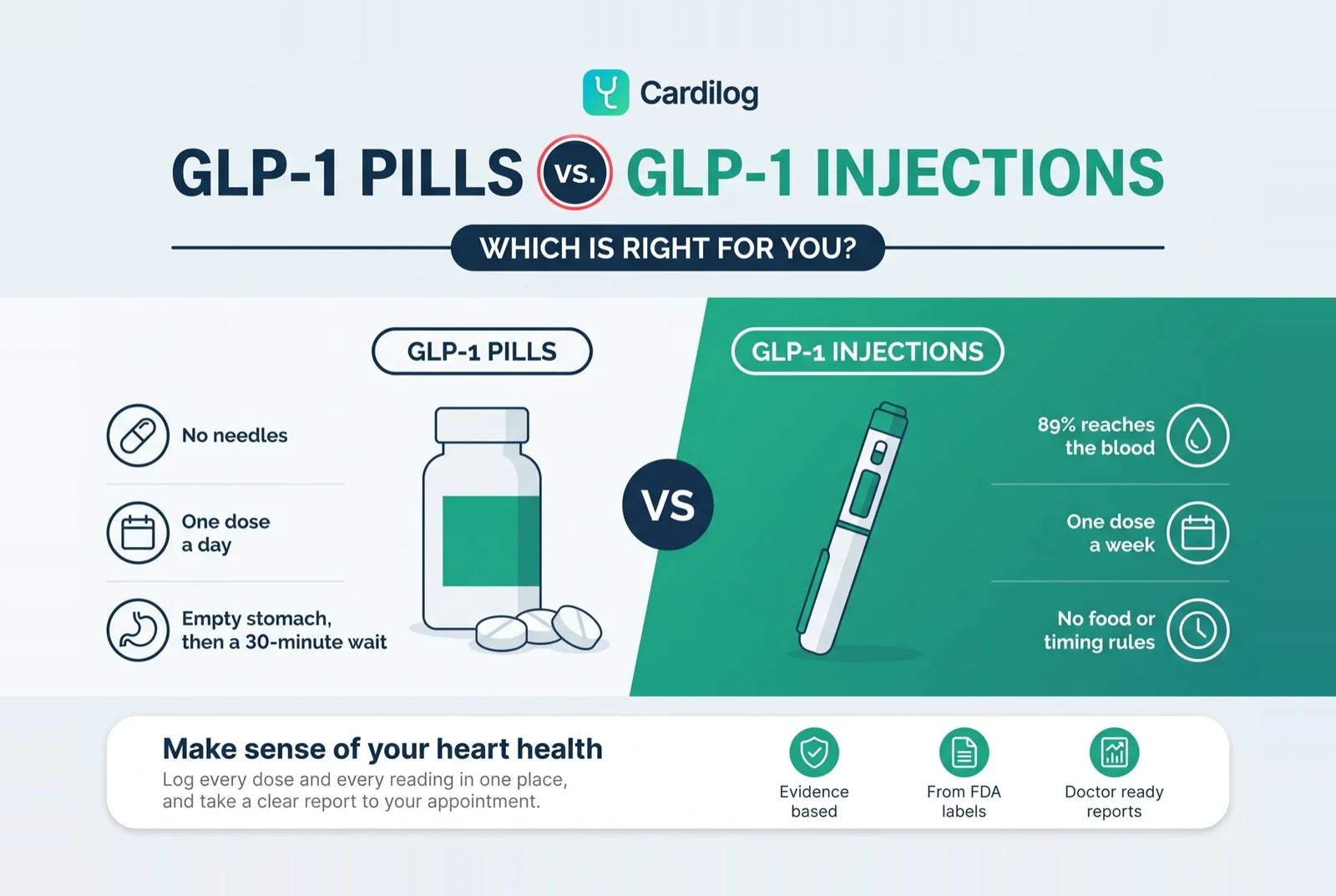
Orforglipron joined that list in August 2026, when the FDA approved it for weight management under the brand name Foundayo. It is a daily tablet that works on the GLP-1 receptor without being a peptide, so it can be taken with or without food and it avoids the empty-stomach routine that oral semaglutide requires. If you are weighing a tablet against a weekly injection, we compared how the tablet and the shot differ on everything else, including how much more the tablet's drug levels vary from person to person.
Retatrutide is the one still in development, and it is worth watching if blood pressure is your main concern. It acts on three receptors at once, and a 2026 meta-analysis found it lowered systolic pressure by 6.8 mmHg and diastolic pressure by 2.5 mmHg, which is the largest effect reported for any drug in this family so far. It is not approved yet, and the evidence base is still small.
Monitoring your blood pressure at home on a GLP-1
Because the change happens slowly and can overshoot, home monitoring is genuinely useful here rather than just good practice. A simple routine works well:
- Take a baseline before your first dose. Measure twice a day for a week so you have a real starting point rather than a single number.
- Measure two or three times a week once you start, at the same times of day, sitting quietly for five minutes beforehand.
- Increase to daily readings for a week after every dose increase, since that is when a drop is most likely to appear.
- Record everything in one place so the trend is visible. A blood pressure log or the Cardilog hypertension tracker gives your doctor something concrete to work from, and our blood pressure chart explains what the numbers mean.
Accuracy depends on the device as much as the routine. If you need one, our guide to blood pressure monitors covers validated options and how to choose the right cuff size.
When to see a doctor
Contact your doctor promptly if you experience any of the following:
- Repeated dizziness or lightheadedness when standing, especially if you take blood pressure medication
- Fainting or nearly fainting at any point
- Home readings that fall below roughly 90/60 mmHg, or any low reading that comes with symptoms
- A resting heart rate that stays noticeably raised, or palpitations that persist
- Blood pressure that rises rather than falls after several weeks of treatment
Seek urgent care for chest pain, severe shortness of breath, confusion, or fainting that comes with any of these.
The bottom line
GLP-1 medications reliably take 2 to 5 mmHg off systolic blood pressure, tirzepatide takes off the most, and the effect comes mostly from weight loss with a genuine contribution from the drugs acting on your kidneys and blood vessels. That is enough to matter for heart risk, and it sits alongside proper blood pressure treatment rather than replacing it.
The honest limitation is what happens next. A 2026 Cochrane review that looked specifically at weight-reducing drugs in people who already have hypertension found that the semaglutide and tirzepatide trials it included reported no results for death, cardiovascular events, or serious adverse events in that population. We know the reading goes down. What that means over years, for people whose main problem is high blood pressure, is still being worked out.