
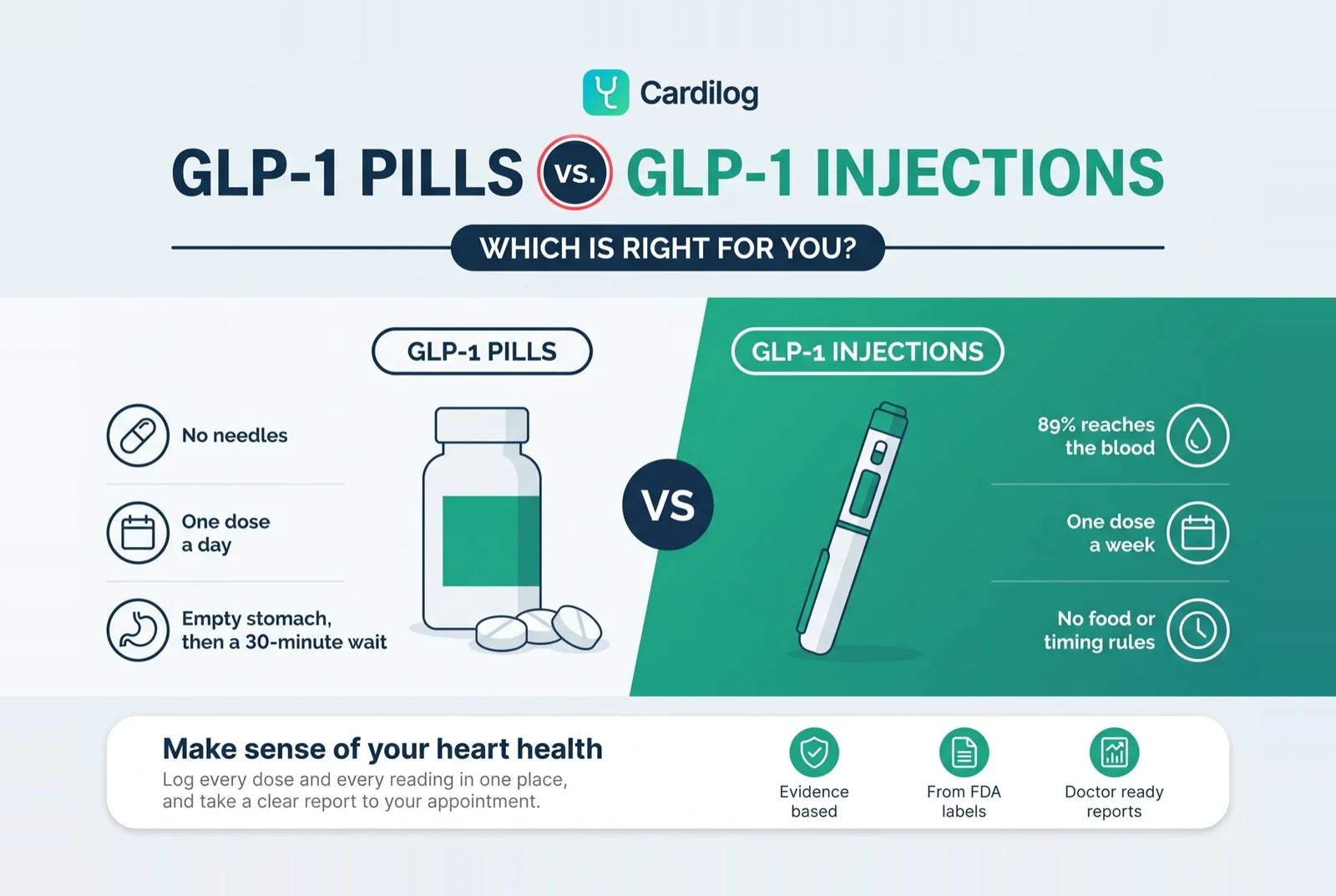
The 25 mg semaglutide tablet reaches almost exactly the same average drug level as the 2.4 mg weekly injection, and it varies much more from one person to the next. Those two facts sit next to each other in the Wegovy prescribing information, and between them they explain most of what matters when you are choosing between a daily pill and a weekly shot.
The rest of the decision comes down to how each one fits your morning, what the side effects feel like, what you pay, and whether you can live with a 30 minute wait before breakfast. This guide goes through all of it using the FDA labels and the published trials, and it says clearly where the evidence is thinner than it looks.
GLP-1 pill vs shot at a glance
Everything in this table comes from the Wegovy prescribing information, which is unusual in covering both the tablet and the injection in a single document. That makes it the cleanest comparison available, because it is the same drug from the same manufacturer measured the same way.
| What you are comparing | Daily tablet | Weekly injection |
|---|---|---|
| How often you take it | Once a day | Once a week |
| How you take it | Empty stomach, up to 4 oz of water, then nothing by mouth for 30 minutes | Injected under the skin of the abdomen, thigh or upper arm, any time of day |
| Where it is absorbed | Mostly in the stomach, helped by SNAC | Directly from the injection site |
| How much of the dose reaches your blood | About 1% to 2% | About 89% |
| Maintenance dose | 25 mg daily | 2.4 mg weekly |
| Average drug level at steady state | About 77 nmol/L | About 75 nmol/L |
| Spread between people | 90% fall between 27 and 186 nmol/L | 90% fall between 51 and 110 nmol/L |
| Weight loss in its main trial | 13.6% at 64 weeks (OASIS 4) | About 15% at 68 weeks (STEP 1) |
| Stopped treatment because of side effects | 6.9%, against 5.9% on placebo | Gastrointestinal side effects caused 4.3% to stop, against 0.7% on placebo |
| Self-pay price at maintenance dose | $299 a month | $349 a month |
Which GLP-1s come as a pill, and which do not
A common question is whether the tirzepatide in Mounjaro and Zepbound comes as a tablet. It does not. Tirzepatide is injection only, and if you want to know what it does to blood pressure specifically we covered that in our guide to Mounjaro, Zepbound and blood pressure. Here is what is actually available by mouth.
| Medication | Form | Brand name | Approved for | Maintenance dose |
|---|---|---|---|---|
| Semaglutide | Tablet | Wegovy tablets | Weight reduction and cardiovascular risk reduction | 25 mg daily |
| Semaglutide | Tablet | Rybelsus | Type 2 diabetes | 7 mg or 14 mg daily |
| Semaglutide | Tablet | Ozempic tablets | Type 2 diabetes | Up to 9 mg daily |
| Semaglutide | Injection | Wegovy | Weight reduction and cardiovascular risk reduction | 2.4 mg weekly |
| Semaglutide | Injection | Ozempic | Type 2 diabetes | Up to 2 mg weekly |
| Orforglipron | Tablet | Foundayo | Weight reduction, approved August 2026 | Up to 17.2 mg daily |
| Tirzepatide | Injection only | Mounjaro, Zepbound | Type 2 diabetes, weight reduction | Up to 15 mg weekly |
| Liraglutide | Injection only | Victoza, Saxenda | Type 2 diabetes, weight reduction | Up to 3 mg daily |
Rybelsus and Ozempic tablets are not interchangeable
How a peptide survives your stomach
Semaglutide is a peptide, which is a short chain of amino acids, essentially a very small protein. Your stomach exists partly to break proteins apart, so swallowing semaglutide should destroy it. The tablet gets around this by being co-formulated with SNAC, an absorption enhancer that briefly raises the pH right around the tablet and helps the drug cross the stomach lining before it is digested. Solis-Herrera and colleagues described how this works in Clinical Diabetes in 2024.
It works, and it is inefficient. The FDA label puts the absolute bioavailability of the tablet at approximately 1% to 2%, compared with 89% for the injection. That is why a 25 mg daily tablet is needed to match a 2.4 mg weekly injection.
Because absorption depends on conditions in the stomach, it is also fragile. The label documents a study where single doses were given with either 50 mL or 240 mL of water after an overnight fast, and absorption differed between the two. It also notes that people with type 2 diabetes reached lower concentrations on the tablet, which the label links to reduced bioavailability in that group. Small details of how you take it genuinely change how much drug you get.
This is worth writing down
Does the pill work as well as the injection?
For weight loss, the two land close together. In OASIS 4, published in the New England Journal of Medicine in 2025, 205 people taking the 25 mg tablet lost 13.6% of their body weight by week 64 against 2.4% on placebo. In STEP 1, the trial behind the 2.4 mg weekly injection, the figure was about 15% at week 68. Those are different trials with different participants and different lengths, so lining them up side by side overstates how much we really know.
Plotkin and colleagues did the arithmetic properly in Diabetes, Obesity and Metabolism in 2026, comparing the two indirectly through their shared placebo arms. They found the injection ahead by about one percentage point, with a confidence interval that comfortably crossed zero, which puts the difference below the five percent threshold regulators treat as clinically meaningful. This was an indirect comparison rather than a head-to-head trial, so it is the best available answer rather than a definitive one.
The one genuine head-to-head test of an oral against an injectable GLP-1 is PIONEER 4, published in The Lancet in 2019, which randomised 711 people with type 2 diabetes to oral semaglutide 14 mg or injected liraglutide 1.8 mg. The tablet matched the injection on blood sugar control and beat it on weight loss. Liraglutide is an older and weaker agent than semaglutide injection, so this does not settle the Wegovy question, and it does show a tablet holding its own against a needle.
Outside trials, Pinto and colleagues compared 105 people with type 2 diabetes taking oral or injectable semaglutide in real practice, reporting in the Journal of Pharmacy Technology in 2025. Neither the difference in HbA1c nor the difference in weight loss reached statistical significance. It was a single-centre retrospective study, so it carries much less weight than the trials, and it points the same way.
Side effects by route
It is the same drug, so it causes the same problems. The FDA label states that in the tablet trial, the types and frequency of common adverse reactions were similar to those seen with the injection. For the 2.4 mg injection, the label lists nausea in 44% of people against 16% on placebo, diarrhoea in 30% against 16%, vomiting in 24% against 6% and constipation in 24% against 11%.
People often assume a tablet must be easier to stay on than a weekly injection. The numbers do not support that. In the tablet trial 6.9% stopped because of side effects, against 5.9% on placebo. For the injection, gastrointestinal side effects caused 4.3% to stop, against 0.7% on placebo. Those come from different trials with different placebo rates, so they cannot be subtracted from one another, and neither route shows a clear advantage in staying power.
Note how you feel, not just what you weigh
What you cannot take with the tablet
The semaglutide tablet has a rule that the injection does not. You take it on an empty stomach, first thing, with no more than four ounces of water and no other liquid. You swallow it whole. Then you wait at least 30 minutes before eating, drinking anything else, or taking any other oral medication.
That last clause is the one most people miss, and it matters if you take blood pressure medication in the morning, which most people do. Starting an oral GLP-1 means deciding which of the two moves, and that is a conversation for your prescriber. Our guide to when to take your blood pressure medication covers what the evidence says about timing.
The reassuring part is that this is a timing problem rather than a drug interaction one. The label reports that oral semaglutide raised levothyroxine exposure by 33%, so thyroid medication needs monitoring. It also reports that lisinopril and furosemide were both tested directly and showed no clinically significant change, alongside metformin, digoxin, warfarin and rosuvastatin. Two of the most commonly prescribed blood pressure medications are therefore on the tested-and-fine list.
Dosing schedules side by side
Both routes start low and climb, for the same reason, which is that going straight to the maintenance dose causes far more nausea. The tablet moves every 30 days and the injection every four weeks, so they reach maintenance at a similar point.
| Step | Wegovy tablet | Wegovy injection |
|---|---|---|
| Starting dose | 1.5 mg daily, days 1 to 30 | 0.25 mg weekly, weeks 1 to 4 |
| Second step | 4 mg daily, days 31 to 60 | 0.5 mg weekly, weeks 5 to 8 |
| Third step | 9 mg daily, days 61 to 90 | 1 mg weekly, weeks 9 to 12 |
| Fourth step | Straight to maintenance | 1.7 mg weekly, weeks 13 to 16 |
| Maintenance | 25 mg daily from day 91 | 2.4 mg weekly from week 17 |
Switching between the pill and the shot
The Wegovy label gives an exact protocol for moving in either direction, which is one of the few places where the tablet and the injection are treated as genuinely interchangeable.
- Injection to tablet: one week after your last 2.4 mg injection, start 25 mg tablets once daily. There is no re-escalation.
- Tablet to injection: the day after your last 25 mg tablet, start 2.4 mg once weekly. Again no re-escalation.
- If the 25 mg tablet was not tolerated, the label suggests considering the 1.7 mg injection instead of the 2.4 mg.
A switch is a good moment to pay closer attention to your readings, because you are changing how the drug arrives while keeping the drug the same. Logging the changeover date in your hypertension tracker gives you a clear before and after to look at.
What each one costs
Novo Nordisk publishes self-pay prices for Wegovy through its own pharmacy, and because the tablet and the injection come from the same company the comparison is unusually direct. These figures are from the price guide dated April 2026 and checked in August 2026.
- Wegovy tablets: $149 a month at 1.5 mg, $199 a month at 4 mg, and $299 a month at both 9 mg and 25 mg.
- Wegovy injection: $349 a month at every dose from 0.25 mg to 2.4 mg. Novo Nordisk has also been running a $199 introductory price covering the first two months for new patients.
- Wegovy HD injection at 7.2 mg: $399 a month.
- With commercial insurance and a savings card, either form can come down to as little as $25 a month, capped at $100 of savings.
A month means one bottle of 30 tablets or one box of four pens. So at maintenance the tablet is about $50 a month cheaper than the injection, which is a real difference and a smaller one than most people expect. Orforglipron is priced separately through Lilly's own pharmacy, and prices for all of these change often enough that you should check directly rather than trusting any figure you read, including this one.
What you actually pay is usually decided by your insurance rather than by the list price, so the self-pay numbers are most useful as a floor if you have no coverage at all.
What each route does to your blood pressure
This is where the published numbers mislead people, and the reason is worth understanding because it applies well beyond this comparison.
Look at the difference-from-placebo column on its own and the tablet looks much weaker, managing 1.6 mmHg where the injection manages 3.4 to 5.1 mmHg. Look at what actually happened to the people taking the drug and the picture changes. The tablet arm's systolic pressure fell 7.0 mmHg, which is at the top of the range the injection arms produced.
| Trial and product | Fall on the drug | Fall on placebo | Difference from placebo | People in the trial |
|---|---|---|---|---|
| Study 7, Wegovy 25 mg tablet | 7.0 mmHg | 5.4 mmHg | 1.6 mmHg | 205 on drug, 102 on placebo |
| Study 2, Wegovy 2.4 mg injection | 6.2 mmHg | 1.1 mmHg | 5.1 mmHg | Obesity or overweight with comorbidity |
| Study 3, Wegovy 2.4 mg injection | 3.9 mmHg | 0.5 mmHg | 3.4 mmHg | Type 2 diabetes with obesity or overweight |
| Study 4, Wegovy 2.4 mg injection | 5.6 mmHg | 1.6 mmHg | 3.9 mmHg | With intensive lifestyle therapy |
| Study 8, Wegovy 7.2 mg injection | 10.8 mmHg | 5.3 mmHg | 5.5 mmHg | 1,005 on drug, 201 on placebo |
The placebo column is the one to read. It ranges from 0.5 mmHg to 5.4 mmHg across these five trials, and a difference-from-placebo figure is only as meaningful as the placebo group it was subtracted from. The tablet trial and the 7.2 mg injection trial both had placebo groups whose pressure fell more than 5 mmHg, which shrinks the apparent drug effect in both. Comparing placebo-adjusted blood pressure numbers across separate trials is unreliable, whichever direction it happens to flatter.
Over the longer term the effect fades. Mulvagh and colleagues analysed cardiovascular risk factors in the SOUL trial for JAMA Cardiology in 2026, following 9,650 people on oral semaglutide 14 mg. Systolic pressure was 3.84 mmHg lower at 13 weeks and 1.83 mmHg lower at 156 weeks, so most of the benefit shows up early and then partly recedes.
On outcomes that matter more than readings, route appears not to matter at all. Lee and colleagues pooled ten trials covering 71,351 people for Diabetes Care in 2025 and found major cardiovascular events reduced by about 14%, with no significant difference between the injectable and oral agents. If you want the fuller picture on this drug class and blood pressure, we cover it in our guide to GLP-1 medications and blood pressure.
If you already take blood pressure medication
Monitoring at home on either one
Home readings are more useful on the tablet than on the injection, for the reason this article opened with. Two people on the same 25 mg dose can end up with drug levels nearly seven times apart, so the trial average tells you less about your own experience than it would on the injection. Measuring yourself closes that gap.
- Take readings at the same time of day, sitting, after five minutes of rest, using the technique in our guide to accurate measurement.
- Check a few times a week rather than daily, because the change builds over months and daily readings mostly show noise.
- Note the dose you are on and the date each time it goes up, since that is when both blood pressure and side effects tend to move.
- Keep checking after you reach maintenance, because weight loss continues and your blood pressure medication may need reviewing.
Cardilog keeps all of that in one place. You can log each dose with its timing, add a note on how you are feeling, and see it plotted against your readings on a blood pressure chart. For the technique itself, our guide to taking accurate blood pressure measurements covers the details that change a reading by several mmHg.
When to see a doctor
Contact your prescriber promptly if you feel dizzy or lightheaded when standing, if you faint, if vomiting or diarrhoea stops you keeping fluids down, or if you get severe abdominal pain that does not settle. Dehydration from gastrointestinal side effects is one of the main reasons blood pressure drops too far on these drugs, and it is more likely if you are already on blood pressure medication.
Book a routine appointment if your home readings are consistently below 100 systolic, if they have dropped substantially since you started, or if you want to discuss switching between the tablet and the injection. Either switch has to be prescribed.
Bring the record, not the recollection
The bottom line
For semaglutide, the tablet and the injection are closer than the dose numbers suggest. They reach nearly identical average drug levels, they produce similar weight loss, they cause the same side effects, and neither shows an advantage in how many people stay on treatment. The injection is marginally ahead on weight loss and costs about $50 a month more at maintenance.
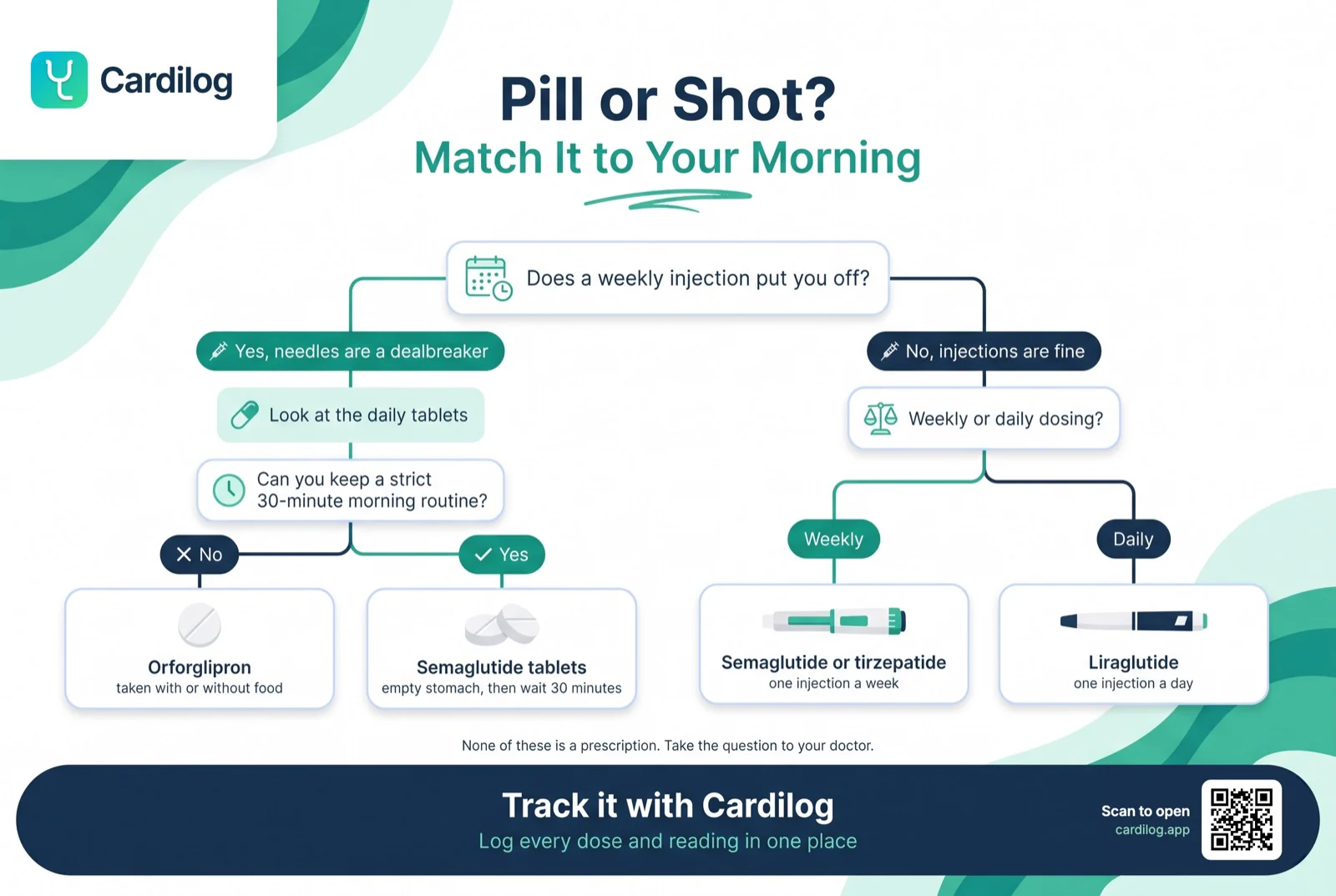
The real difference is predictability. The tablet's drug levels vary about three times as widely between people, and how you take it genuinely affects how much you absorb. If you would rather not inject, the tablet is a legitimate choice, and it asks more of you in exchange: an empty stomach, a small sip of water, 30 minutes of patience, and a bit more attention to what your own numbers are doing.