
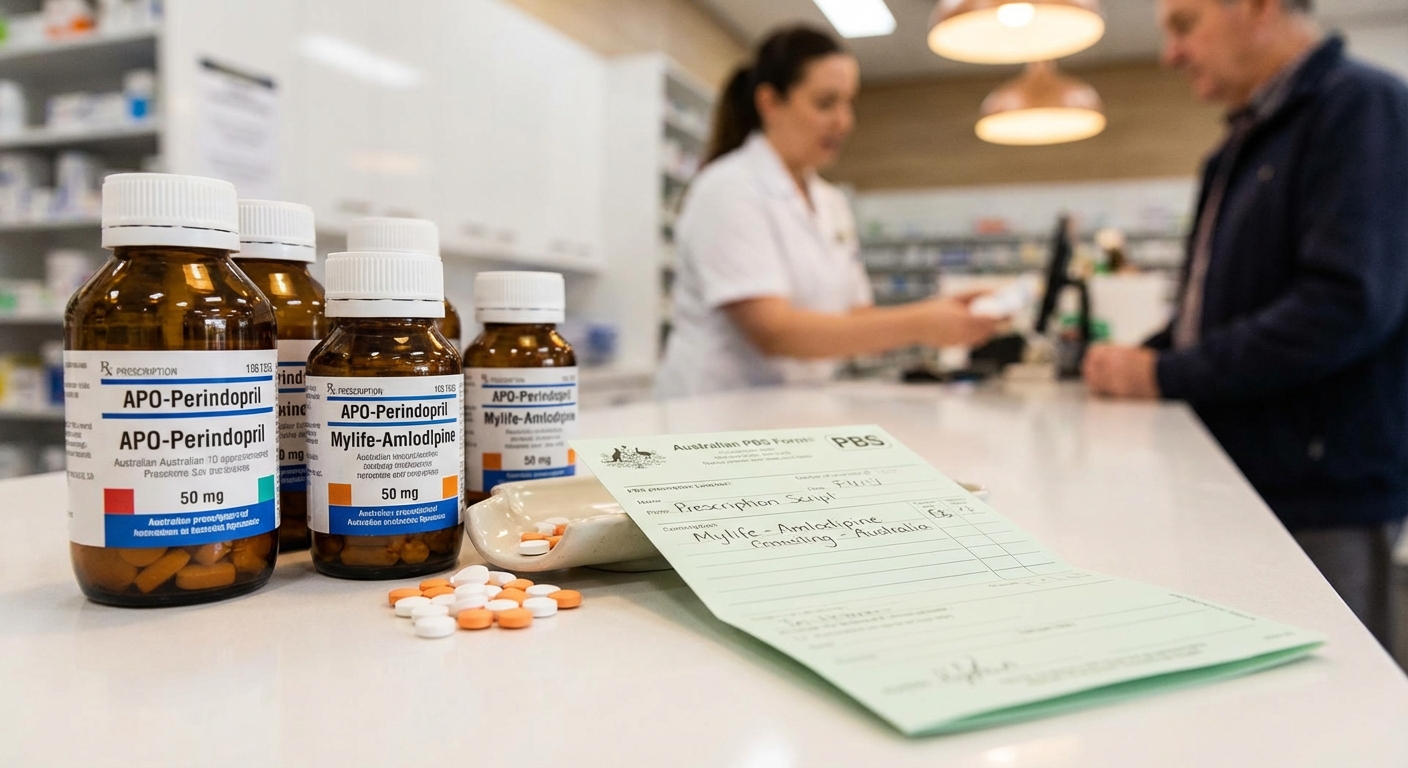
Most blood pressure medication in Australia is subsidised by the Pharmaceutical Benefits Scheme (PBS), so in 2026 most scripts cost you up to $25.00, or $7.70 if you have a concession card, according to the PBS website. Common tablets include perindopril (Coversyl), amlodipine (Norvasc), telmisartan (Micardis), irbesartan (Avapro, Karvea) and candesartan (Atacand). These original brands carry a brand premium on top of the co-payment, and each medicine also comes in premium-free brands that cost less. Since April 2026, your GP can also start treatment with a two-in-one tablet, such as perindopril with amlodipine. All blood pressure tablets need a prescription, which you can get from your GP in person or by telehealth. This guide lists the common tablets by name and brand, explains what you will pay, and covers repeats, 60-day scripts and generics.
How much does blood pressure medication cost in Australia?
In 2026, a PBS script for most blood pressure medicines costs you up to $25.00, or $7.70 if you have a concession card, and you pay more only if you choose a brand that carries a brand premium.
The Pharmaceutical Benefits Scheme (PBS) subsidises most blood pressure medications in Australia. From 1 January 2026, the PBS co-payment changed to make medications more affordable.
2026 PBS co-payment prices
As of January 2026, you pay:
- General patients: Maximum $25.00 per prescription (reduced from $31.60)
- Concession card holders: $7.70 per prescription (frozen at this amount until 1 January 2030)
If you are a general patient and your medicine costs less than $25, you pay the pharmacy's price for it, which can vary between pharmacies. For these cheaper medicines, the pharmacy can add an allowable extra charge of up to $2.79 in 2026, but the total can never go above $25.
New in 2026: Single-pill combination therapies
On 1 April 2026, the PBS changed its rules "to allow fixed dose combinations (FDCs) for dual therapy antihypertensives to be used as a first-line treatment for hypertension". In plain terms, your GP can now start your treatment with a single-pill combination, one tablet that holds two blood pressure medicines. The PBS says the change follows international clinical guidelines and the recommendations of the National Hypertension Taskforce of Australia. The Heart Foundation welcomed it, saying people are more likely to take their medicine as prescribed when treatment is simple.
Instead of taking two separate tablets, you can now get both medications in one pill. This makes it easier to stick to treatment and reduces the chance of missing doses.
Common PBS-listed combinations include perindopril + amlodipine, telmisartan + amlodipine, and irbesartan + hydrochlorothiazide. Ask your GP if a combination pill is right for you.
The 5 main types of blood pressure tablets
The five main types of blood pressure tablets used in Australia are ACE inhibitors, ARBs, calcium channel blockers, beta blockers and diuretics. Each class lowers blood pressure in a different way, and the sections below show how to recognise them and the brand names you may see on the box.
1. ACE inhibitors
ACE inhibitors (angiotensin-converting enzyme inhibitors) relax blood vessels by blocking the production of angiotensin II, a hormone that narrows blood vessels.
How to recognise them: Names end in -pril.
Common Australian brands: Perindopril (Coversyl, Prexum), enalapril (Renitec), ramipril (Tritace, Prilace), lisinopril (Zestril).
Best for: Younger adults, people with diabetes or kidney disease, heart failure patients.
Common side effects: Dry cough (10-20% of users), dizziness, elevated potassium levels. The cough can be persistent and annoying. If it bothers you, your GP can switch you to an ARB.
2. ARBs (Angiotensin receptor blockers)
ARBs work similarly to ACE inhibitors but block angiotensin II at the receptor level instead of blocking its production. They are often used when ACE inhibitors cause a cough.
How to recognise them: Names end in -sartan.
Common Australian brands: Irbesartan (Avapro, Karvea), candesartan (Atacand), telmisartan (Micardis), valsartan (Diovan), olmesartan (Olmetec).
Best for: People who cannot tolerate ACE inhibitors (due to cough), diabetes, kidney disease.
Common side effects: Dizziness, elevated potassium, headache. Generally well tolerated with fewer side effects than ACE inhibitors.
3. Calcium channel blockers
Calcium channel blockers prevent calcium from entering heart muscle and blood vessel cells, which relaxes the blood vessels and reduces heart workload.
Common Australian brands: Amlodipine (Norvasc), felodipine (Plendil), lercanidipine (Zanidip), verapamil (Isoptin), diltiazem (Cardizem).
Best for: Older adults (over 55), people who also have angina (chest pain), some types of arrhythmias.
Common side effects: Ankle swelling (especially amlodipine), flushing, headache, dizziness. The swelling is harmless but can be uncomfortable.
4. Beta blockers
Beta blockers slow down your heart rate and reduce the force of heartbeats, which lowers blood pressure. They are often used after a heart attack or for people with heart failure.
How to recognise them: Names end in -lol.
Common Australian brands: Metoprolol (Betaloc, Minax), atenolol (Tenormin), bisoprolol (Bicor), carvedilol (Dilatrend), nebivolol (Nebilet).
Best for: People with a history of heart attack, heart failure, angina, or certain types of irregular heartbeat.
Common side effects: Fatigue, cold hands and feet, dizziness, weight gain (1-3kg), difficulty exercising at high intensity.
5. Diuretics
Diuretics (water tablets) help your kidneys remove extra salt and water from your body through urine. This reduces the volume of fluid in your blood vessels, lowering pressure.
How to recognise them: Thiazide diuretics often end in -zide.
Common Australian brands: Hydrochlorothiazide (Dithiazide), indapamide (Dapa-Tabs, Natrilix SR), chlorthalidone, spironolactone (Aldactone, Spiractin). Combination products like Moduretic (amiloride + hydrochlorothiazide) are also common.
Best for: Older adults, people with fluid retention, often used in combination with other blood pressure medications.
Common side effects: Increased urination (especially in the first few weeks), low potassium or sodium, dizziness when standing, gout flare-ups in people who are susceptible.
Common blood pressure tablets in Australia: names and brands
These are the blood pressure tablets Australian GPs commonly prescribe, with their brand names and the 2026 PBS co-payment. According to the PBS Expenditure and Prescriptions Report for 2024-25, the blood pressure medicines dispensed most often on the PBS that year were perindopril, amlodipine, telmisartan, candesartan and irbesartan.
| Generic name | Common brand names | Class | PBS co-payment |
|---|---|---|---|
| Perindopril | Coversyl*, Prexum | ACE inhibitor | $25 / $7.70 |
| Irbesartan | Avapro*, Karvea* | ARB | $25 / $7.70 |
| Amlodipine | Norvasc* | Calcium channel blocker | $25 / $7.70 |
| Candesartan | Atacand* | ARB | $25 / $7.70 |
| Telmisartan | Micardis* | ARB | $25 / $7.70 |
| Metoprolol | Betaloc*, Minax | Beta blocker | $25 / $7.70 |
| Hydrochlorothiazide | Dithiazide | Diuretic | $25 / $7.70 |
| Enalapril | Renitec* | ACE inhibitor | $25 / $7.70 |
| Ramipril | Tritace, Prilace | ACE inhibitor | $25 / $7.70 |
| Valsartan | Diovan | ARB | $25 / $7.70 |
| Indapamide | Dapa-Tabs, Natrilix SR | Diuretic | $25 / $7.70 |
| Bisoprolol | Bicor* | Beta blocker | $25 / $7.70 |
| Atenolol | Tenormin*, Noten | Beta blocker | $25 / $7.70 |
| Lercanidipine | Zanidip*, Lercan | Calcium channel blocker | $25 / $7.70 |
| Perindopril + amlodipine | Coveram*, Reaptan | ACE inhibitor + calcium channel blocker | $25 / $7.70 |
| Perindopril + indapamide | Coversyl Plus*, Prexum Combi | ACE inhibitor + diuretic | $25 / $7.70 |
| Telmisartan + amlodipine | Twilem | ARB + calcium channel blocker | $25 / $7.70 |
| Irbesartan + hydrochlorothiazide | Avapro HCT*, Abisart HCTZ | ARB + diuretic | $25 / $7.70 |
Note: Co-payment is shown as general / concession, and it is the most you pay for a PBS script of a premium-free brand. Brands marked * carry a brand premium, an extra charge you pay on top of the co-payment, and every medicine in this table also comes in premium-free brands, so ask your pharmacist if cost matters to you. Many of these tablets cost general patients a little less than $25 on a one-month script, because their full price is below the co-payment.
How to get a blood pressure prescription in Australia
There are three main ways to get a blood pressure prescription in Australia: in-person GP visit, telehealth consultation, or online doctor service.
In-person GP visit
Book an appointment with your regular GP. They will check your blood pressure, review your medical history, and write a prescription if needed. This is the most common route for initial prescriptions.
Your GP may also order blood tests to check kidney function and electrolyte levels before starting certain medications.
Telehealth (phone or video consultation)
Many GP clinics now offer telehealth appointments via phone or video call. Your doctor can send an electronic prescription (eToken) directly to your phone via SMS or email. You can fill it at any pharmacy that supports electronic prescriptions, which most pharmacies do.
Telehealth is convenient for repeat prescriptions and medication reviews. However, initial prescriptions often require an in-person visit so your GP can check your blood pressure directly.
Online doctor platforms
Online doctor services also offer consultations for blood pressure prescriptions. Their fees vary, so check the cost before you book.
The doctor will review your health history and current blood pressure readings (you may need to provide recent measurements). If appropriate, they send an electronic prescription to your phone.
Electronic prescriptions (eTokens)
Most blood pressure prescriptions in Australia are now issued electronically. Your GP sends a prescription token (QR code or number) to your phone via SMS or email.
You show the code at any pharmacy that supports electronic prescriptions, which most pharmacies in Australia do. If you register for an Active Script List, your electronic prescriptions are kept in one list, so with your consent a participating pharmacist can dispense them without the token.
Electronic prescriptions are convenient because you do not need to carry paper scripts, and you cannot lose them. Some pharmacies also offer prescription delivery services.
Repeats and 60-day scripts
Most blood pressure scripts in Australia come with up to 5 repeats. On a standard one-month script that lasts about six months, and on a 60-day script, which gives you two months of tablets each time, it can last up to a year.
Many blood pressure medicines can be prescribed as 60-day scripts, and each two-month fill costs one PBS co-payment. The Australian Government brought 60-day scripts in on 1 September 2023 and added more medicines on 1 March and 1 September 2024. Perindopril, amlodipine, telmisartan, candesartan and irbesartan are all on the list, and the PBS website keeps the current list of eligible medicines. Your GP decides whether your condition is stable enough for a 60-day script, so ask your GP or pharmacist whether yours is on the list.
A PBS script is valid for 12 months from the date it was written. After you use all your repeats, or the script expires, you need to see your GP again to get a new prescription.
A few medicines come with fewer repeats. Check with your pharmacist if you are unsure how many repeats you have left.
My Health Record and blood pressure medications
My Health Record is a secure online summary of your health information. Your blood pressure prescriptions are automatically uploaded to your record when your doctor or pharmacist uses an electronic system.
You can view your prescription history, dispensing records, and medication lists through the My Health Record app or website. This is useful if you see multiple doctors or need to remember which medications you have tried in the past.
Pharmacists can also check your My Health Record to see if you have allergies or drug interactions before dispensing a new medication.
Generic or brand name: which is better?
Generic tablets work in the same way as brand-name tablets and are cheaper in most cases, according to the Australian Government's guide to PBS co-payments, so for most people the generic is the better-value choice.
Generic medications contain the same active ingredient and dose as brand-name versions. They are just as effective and must meet the same quality standards set by the Therapeutic Goods Administration (TGA).
For PBS prescriptions, the co-payment is the same for a generic and a brand ($25 or $7.70 at most). Some brands also carry a brand premium, an extra charge you pay on top of the co-payment that does not count toward your Safety Net. For private (non-PBS) prescriptions, generics are usually cheaper too.
Your pharmacist will usually give you the generic version unless your doctor writes "no substitution" on the prescription. If you prefer a specific brand, ask your doctor to note that on the script.
When lifestyle changes are enough vs when medication is needed
Not everyone with high blood pressure needs medication right away. Your GP will decide based on how high your blood pressure is and your other risk factors.
Lifestyle changes alone may be enough if:
- Your blood pressure is in the high-normal range (120-139 / 80-89 mmHg)
- You do not have diabetes, kidney disease, or other cardiovascular risk factors
- You are willing and able to make significant lifestyle changes
Medication is usually recommended if:
- Your blood pressure is consistently 140/90 mmHg or higher
- You have diabetes, kidney disease, or a history of heart attack or stroke
- Your blood pressure is 160/100 mmHg or higher (medication needed immediately)
- Lifestyle changes alone have not lowered your blood pressure after 3-6 months
Even if you take medication, lifestyle changes still matter. Regular exercise, a healthy diet, reducing salt, losing weight, and managing stress can reduce the dose of medication you need or help you avoid needing a second medication.
Monitoring your blood pressure at home
If you take blood pressure medication, your GP will likely recommend checking your blood pressure at home. Home monitoring helps you and your doctor see how well the medication is working and whether the dose needs adjustment.
Follow proper measurement techniques to get accurate readings. Check at the same time each day, sit quietly for 5 minutes first, and keep a record of your readings.
Apps like Cardilog can help you track your blood pressure over time, log your medications, and share trends with your doctor. Regular tracking makes it easier to spot patterns and adjust treatment.
What to do if you experience side effects
All blood pressure medications can cause side effects, although not everyone gets them. Common side effects include dizziness, headache, fatigue, and dry cough (ACE inhibitors).
If you experience mild side effects, they often improve after a few weeks as your body adjusts. Do not stop taking your medication without talking to your GP first.
Contact your GP if you experience:
- Persistent or severe side effects that interfere with daily life
- Dizziness or fainting, especially when standing up
- Swelling of the face, lips, or tongue (stop medication immediately and seek medical help, this can be a serious allergic reaction)
- Rapid or irregular heartbeat
- Persistent cough (common with ACE inhibitors)
Your GP can switch you to a different medication class, adjust the dose, or add a second medication to reduce side effects while still controlling your blood pressure. If you want a second opinion before anything changes, you can request a consult with a cardiologist and talk through your history and readings.
Final thoughts
Blood pressure medication is widely available and affordable in Australia thanks to the PBS. With the 2026 co-payment reduction and the April 2026 change that lets your GP start treatment with a single-pill combination, treatment is more convenient and cost-effective than ever.
Work with your GP to find the right medication and dose for you. Be patient, it may take a few tries to find what works best. Monitor your blood pressure at home, take your medication consistently, and combine it with healthy lifestyle changes for the best results.
If you have questions about your prescription, co-payment costs, or side effects, talk to your GP or pharmacist. They can help you navigate the PBS system and make sure you are getting the most effective treatment at the lowest cost.
For a broader overview of how each drug class works, see our blood pressure medication guide. You can also learn about medication side effects by drug class and whether blood pressure medication causes weight gain.