

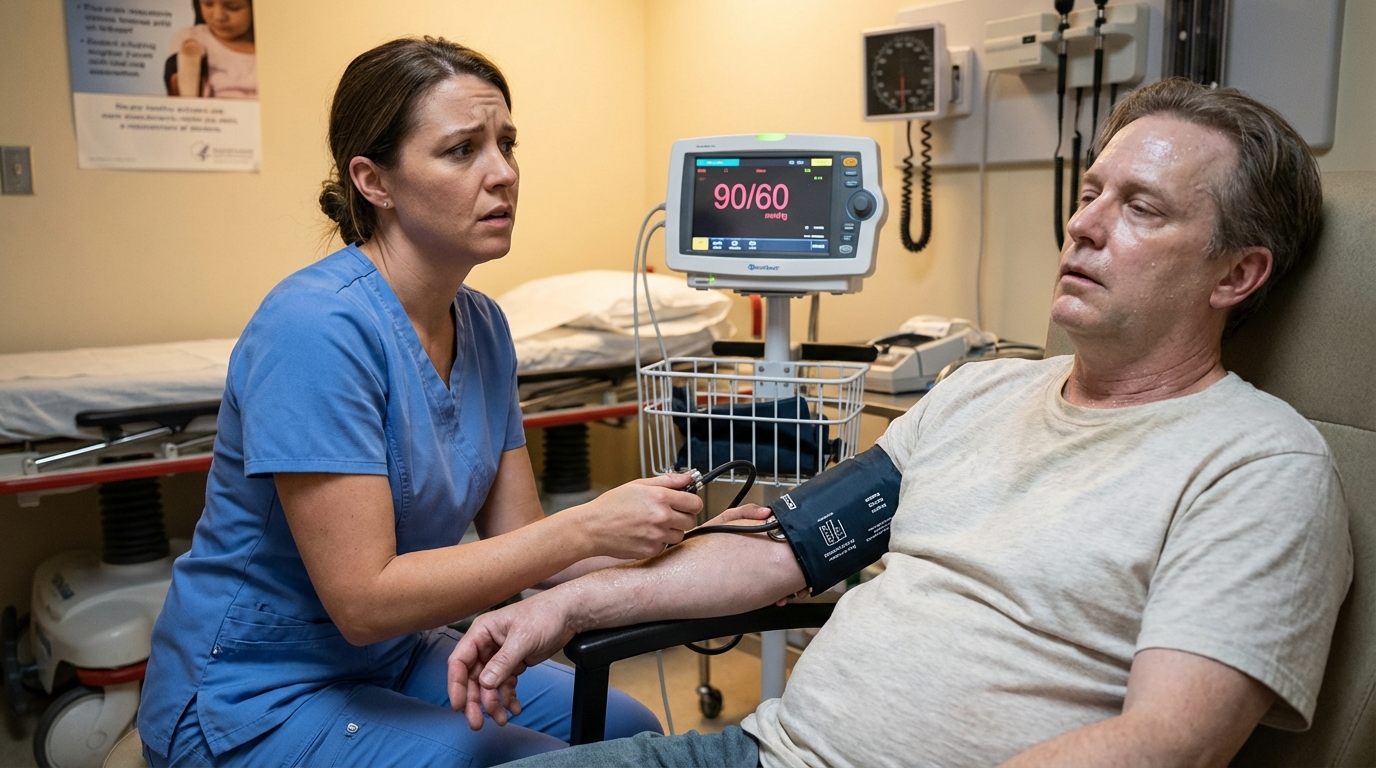
Defining dangerous low blood pressure
Blood pressure is "low" when it falls below 90/60 mmHg. That is the textbook definition of hypotension. But "low" does not automatically mean "dangerous." Some people function perfectly well with readings around 90/60 or even 85/55. Athletes, young women, and people who are physically fit often have naturally low blood pressure with no symptoms.
Dangerous low blood pressure is when the numbers drop low enough that vital organs are not getting adequate blood flow. This typically happens when systolic pressure falls below 70-80 mmHg or diastolic falls below 40 mmHg, especially if the drop is sudden. At those levels, the brain, kidneys, and heart start to struggle.
| Blood Pressure Range | Classification | Risk Level | What It Means |
|---|---|---|---|
| 90-100/60-70 mmHg | Mildly low | Low risk | Often normal for healthy adults; monitor for symptoms |
| 80-89/50-59 mmHg | Low | Moderate risk | May cause dizziness, fatigue; see a doctor if symptomatic |
| 70-79/40-49 mmHg | Very low | High risk | Likely symptomatic; medical evaluation needed urgently |
| Below 70/40 mmHg | Critically low | Emergency | Shock likely; call 000 immediately |
These thresholds are guidelines. The real marker of danger is how you feel. If you are at 88/58 and feel perfectly fine, that is your normal. If you are at 95/65 and feel dizzy, weak, or confused, that is a problem.
Dangerous low blood pressure thresholds by group
Women
Women naturally tend to have lower blood pressure than men, especially during the reproductive years. Readings around 100/60 or even 90/60 are common and usually harmless. But when blood pressure drops below 70/40 mmHg in women, it becomes dangerous.
For women, the danger zone is:
- Systolic below 80 mmHg with symptoms
- Systolic below 70 mmHg regardless of symptoms
- Any reading with signs of shock (see below)
Men
Men typically have slightly higher baseline blood pressure than women. Readings below 90/60 mmHg are less common in men and more likely to indicate an underlying problem. For men, dangerous thresholds are:
- Systolic below 85 mmHg with symptoms like dizziness or chest pain
- Systolic below 75 mmHg regardless of symptoms
- Sudden drops of 20 mmHg or more from baseline, even if still above 90 mmHg
Elderly people (over 65)
For older adults, the danger threshold for low blood pressure is higher. Research shows that systolic blood pressure below 100 mmHg in people over 65 is associated with increased mortality, especially in those with heart disease or frailty.
Why? Older adults have stiffer blood vessels and less responsive reflexes that normally compensate for blood pressure changes. When pressure drops, the brain does not get enough blood. This causes dizziness, falls, confusion, and cognitive decline.
| Age Group | Concerning BP (Systolic) | Dangerous BP (Systolic) | Primary Risk |
|---|---|---|---|
| 18-40 years | Below 90 mmHg | Below 70 mmHg | Fainting, injury from falls |
| 40-65 years | Below 95 mmHg | Below 75 mmHg | Dizziness, organ hypoperfusion |
| Over 65 years | Below 100 mmHg | Below 85 mmHg | Falls, cognitive impairment, mortality |
Low BP in elderly: higher danger
Pregnant women
Blood pressure drops naturally during pregnancy, especially in the first and second trimesters. Systolic pressure often falls by 5-10 mmHg, and diastolic by 10-15 mmHg. This is caused by progesterone, which relaxes blood vessels.
For pregnant women, these ranges apply:
- Normal pregnancy: 90-120/60-80 mmHg (lower than non-pregnant baseline)
- Concerning: systolic below 90 mmHg or diastolic below 55 mmHg
- Dangerous: below 80/50 mmHg, especially with dizziness or fainting
If you are pregnant and your blood pressure is below 80/50 mmHg, or you are experiencing frequent dizziness, fainting, or blurred vision, call your midwife or doctor immediately. Low blood pressure in pregnancy can reduce blood flow to the placenta, which affects the baby.
Emergency symptoms of dangerously low blood pressure
Numbers alone do not tell the full story. What makes low blood pressure dangerous is when it stops your organs from working properly. This state is called shock, and it is a medical emergency.
Call 000 immediately if you or someone else has
• Rapid, shallow breathing
• Weak, rapid, or irregular pulse
• Confusion, inability to focus, or slurred speech
• Loss of consciousness or unresponsiveness
• Blue lips or fingernails (cyanosis)
• Chest pain or severe shortness of breath
• Inability to stand without fainting
These are signs of shock. Shock means the circulatory system has failed to deliver enough oxygen to tissues. Without immediate treatment, shock leads to organ failure and death within minutes to hours.
Types of shock related to low blood pressure
| Type of Shock | Cause | Typical BP | Key Symptoms |
|---|---|---|---|
| Hypovolemic shock | Blood loss or severe dehydration | Below 80/50 mmHg | Thirst, rapid pulse, cold skin, confusion |
| Cardiogenic shock | Heart failure or heart attack | Below 90/60 mmHg | Chest pain, shortness of breath, rapid pulse |
| Septic shock | Severe infection (sepsis) | Below 90/60 mmHg | Fever or very low temperature, confusion, fast breathing |
| Anaphylactic shock | Severe allergic reaction | Below 90/60 mmHg | Hives, swelling, difficulty breathing, rapid pulse |
| Neurogenic shock | Spinal cord injury | Below 90/60 mmHg | Slow pulse (unusual in shock), warm skin, paralysis |
All of these require immediate emergency care. Do not wait to see if symptoms improve. Call 000 and get to a hospital.
Common causes of dangerously low blood pressure
- Severe dehydration: From vomiting, diarrhea, heat exposure, or not drinking enough fluids. Blood volume drops, and pressure follows.
- Blood loss: Internal or external bleeding from trauma, surgery, gastrointestinal bleeding, or ruptured aneurysm.
- Heart problems: Heart attack, heart failure, severe bradycardia (very slow heart rate), or heart valve disease. If the heart cannot pump effectively, pressure drops.
- Severe infection (sepsis): Bacteria in the bloodstream release toxins that dilate blood vessels. Blood pressure can collapse rapidly.
- Allergic reaction (anaphylaxis): Severe allergies to food, insect stings, or medication can cause rapid blood pressure drop within minutes.
- Medication side effects: Blood pressure medications, diuretics, beta-blockers, antidepressants, or medications for Parkinson's disease can all cause excessive blood pressure drops.
- Endocrine disorders: Addison's disease (adrenal insufficiency), severe hypothyroidism, or diabetes with very low blood sugar.
What to do if your blood pressure is dangerously low
If you are alone and feel faint or dizzy
- Lie down immediately with your feet elevated above your heart level
- Do not try to stand up or walk
- Call 000 or have someone nearby call for help
- If you have water nearby, drink it slowly (unless you are vomiting)
- Stay lying down until help arrives, even if you start to feel better
If someone else is showing signs of shock
- Call 000 immediately
- Lay the person flat on their back and elevate their legs about 30 cm (unless there is a head, neck, or back injury)
- Keep them warm with a blanket, but do not overheat
- Do not give them anything to eat or drink
- If they are unconscious but breathing, place them in the recovery position
- Monitor breathing and pulse until paramedics arrive
Follow-up after a low blood pressure episode
Even if symptoms resolve and you feel better, you need medical evaluation after an episode of dangerously low blood pressure. The underlying cause must be identified and treated. Common tests include:
- Blood tests (full blood count, electrolytes, kidney and liver function, blood sugar)
- ECG (electrocardiogram) to check heart rhythm
- Echocardiogram to assess heart function and valve problems
- Tilt table test to diagnose orthostatic hypotension or vasovagal syncope
- Review of all medications to identify potential culprits
When to see a doctor (non-emergency scenarios)
Not all low blood pressure requires a 000 call, but you should see your GP or go to an urgent care clinic if you have:
- Persistent dizziness when standing up
- Frequent lightheadedness that interferes with daily activities
- Blood pressure consistently below 90/60 mmHg on home monitoring
- New or worsening fatigue with low blood pressure readings
- Blurred vision or difficulty concentrating
- Recent medication changes and new low blood pressure symptoms
Your doctor will investigate whether your low blood pressure is a benign variation or a sign of an underlying condition that needs treatment.
The bottom line
Dangerous low blood pressure is not just about hitting a specific number. It is about whether your body is getting enough blood flow to function. For most people, readings below 70/40 mmHg are dangerous, but elderly people can be at risk even at 100/60 mmHg. Pregnant women naturally run lower, but anything below 80/50 mmHg needs urgent assessment.
The key is symptoms. If you feel faint, confused, cold, or short of breath, your blood pressure is too low for you, regardless of the number. Call 000 if you or someone else shows signs of shock. Track your blood pressure regularly if you have symptoms, and share that data with your doctor to guide diagnosis and treatment.